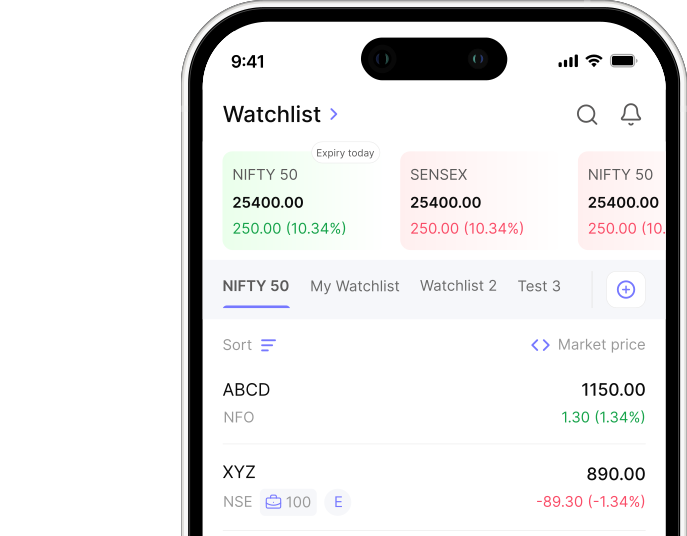
What is NSE? India's Largest Stock Exchange Guide
NSE, the National Stock Exchange of India, is the country's largest stock exchange by trading volume. It was set up in 1992 with one clear mission: bring technology and transparency to Indian stock markets, which at the time were manual, opaque, and accessible only to those who could physically be present on trading floors.
Before NSE launched electronic trading in 1994, traders would shout orders at each other on exchange floors. A broker in Delhi had no easy way to trade at prices from Mumbai. NSE changed all of this. Within a few years, any investor from any corner of India could participate in markets at the same prices.
Why does NSE matter so much to Indian investors today?
NSE is the exchange where most of India's stock market activity happens. It has the highest trading volumes, the most liquid markets, and it hosts the F&O segment where futures and options on stocks and indices are traded. The NIFTY 50, India's most watched market index, is a product of NSE.
If you have invested in a mutual fund in India, chances are its performance is benchmarked against the NIFTY 50. If you have traded options, you have almost certainly done it on NSE. The exchange is central to how most Indians interact with capital markets.
What is the NIFTY 50?
The NIFTY 50 is NSE's flagship index. It tracks 50 of the largest and most liquid companies across sectors. Companies like Reliance Industries, HDFC Bank, TCS, Infosys, and Bajaj Finance are all part of it.
NIFTY 50 = 50 largest NSE-listed companies = India's primary market benchmark
The index is reviewed and rebalanced twice a year by NSE's index committee. Companies that no longer meet the criteria are replaced. The NIFTY 50 is available as an investment product through index funds and ETFs listed on NSE itself.
What are the key features of NSE?
| Feature | Details |
|---|---|
| Founded | 1992 |
| Main Index | NIFTY 50 (50 stocks) |
| Daily Volume | Highest in India |
| F&O Market | Primary F&O exchange in India |
| Technology | First fully electronic exchange in India (1994) |
| Regulator | SEBI |
How do I access NSE?
You trade on NSE through a SEBI-registered stockbroker. You need a demat account to hold your shares and a trading account to place orders. Once your accounts are active, you can buy stocks, ETFs, mutual fund units, and F&O contracts listed on NSE during market hours, which are 9:15 AM to 3:30 PM on weekdays.
Open your account at stockk.trade to get access to both NSE and BSE listed instruments.
Frequently Asked Questions
I want to invest in the NIFTY 50 index. How do I do that?
You cannot buy the NIFTY 50 index directly, but you can invest in it through NIFTY 50 index mutual funds or NIFTY 50 ETFs listed on NSE. Both track the index closely. ETFs trade like stocks during market hours. Index funds are bought and sold at end-of-day NAV through a fund house or broker.
Is F&O trading on NSE suitable for beginners?
F&O trading requires understanding of how derivatives work, margin requirements, and risk management. Most market experts suggest that beginners start with equity investing before exploring F&O. SEBI data shows that the majority of individual F&O traders lose money. If you want to explore F&O, start with small amounts and consider speaking with a SEBI-registered adviser first.
How does NSE ensure that trades are settled correctly?
NSE works with NSE Clearing Limited, its clearing corporation, which guarantees settlement of all trades. If a broker defaults, the clearing corporation uses its guarantee fund to complete the settlement. India moved to T+1 settlement in 2023, meaning shares are credited to your demat account one trading day after the trade.
What sectors are covered by the NIFTY 50?
The NIFTY 50 covers financial services, information technology, oil and gas, consumer goods, automotive, pharmaceuticals, metals, and real estate among others. Financial services and IT tend to have the highest combined weight. The exact weightings change as market capitalisations of constituent companies change.
Can I place orders on NSE outside trading hours?
Yes. Most brokers allow you to place after-market orders (AMO) outside regular hours. These orders are submitted to the exchange when it opens the next trading day. There is also a pre-open session from 9:00 AM to 9:15 AM where orders are collected to determine the opening price of stocks.
Disclaimer: Investments in the securities market are subject to market risks. Please read all related documents carefully before investing. This article is intended for informational and knowledge purposes only and should not be considered tax, financial, or investment advice. Tax laws and deductions may vary based on individual circumstances and regulatory changes. Readers are advised to consult a qualified tax advisor or financial professional before making any investment or tax planning decisions.
Indira Securities Private Limited (SEBI Reg. No.): NSE TM ID: 12866 | BSE TM ID: 663 | CDSL DPID: 17000 | SEBI Reg. No.: INZ000188930 | MCX TM ID: 56470 | NCDEX TM ID: 01277 | CDSL Reg. No.: IN-DP-90-2015 | CIN:U67120MP1996PTC085111 | RA SEBI Reg. No.: INH000023269 | IA SEBI Reg. No.: INA000021410 | SEBI Merchant Banking Reg. No.: INM000013536