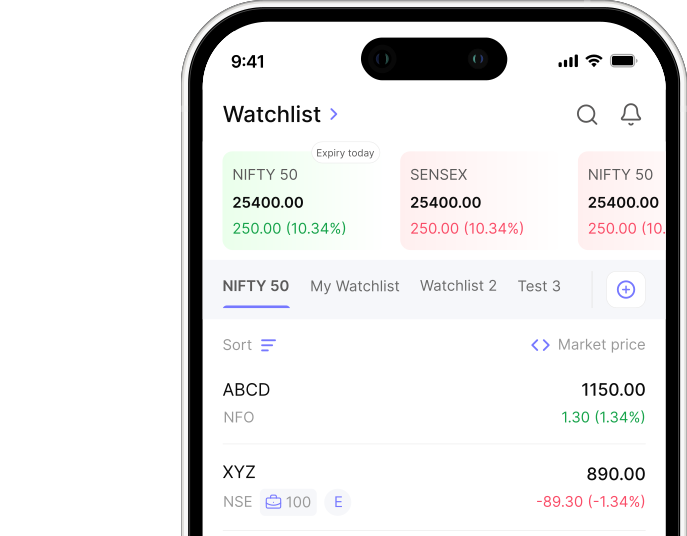
What is an ETF (Exchange-Traded Fund)? A Simple Guide
An ETF is a fund that trades on the stock exchange like a share, usually tracking an index, commodity or sector. You buy and sell ETF units at live market prices through a demat account. ETFs combine the diversification of a fund with the flexibility of a stock.
An ETF blends two worlds: it is a diversified fund, but it trades on the exchange like a single stock. You buy and sell it live during market hours.
The sections below explain it step by step, without the jargon. You can explore investing on Stockk.
Key Takeaways
- An ETF trades on the exchange like a share.
- It usually tracks an index, sector or commodity.
- You buy and sell it at live prices via a demat account.
- It combines fund diversification with stock flexibility.
- It typically has a low expense ratio.
How does an ETF work?
An ETF holds a basket of assets and its units are listed on the exchange. Many ETFs track an index, but that is not the only kind. Commodity ETFs hold assets like gold or silver, and there are ETFs for specific sectors and themes too. Unlike a regular mutual fund priced once a day, an ETF trades continuously at live market prices, and you need a demat and trading account to buy and sell units, just like shares.
Consider you buy units of a NIFTY 50 ETF during market hours. You pay the live traded price, and your units track the NIFTY 50 index, giving you broad market exposure in a single, tradable instrument.
Are all ETFs based on an index?
Commodity ETFs are a common example beyond index tracking. A gold ETF, for instance, holds gold and its price closely follows the metal, letting you invest in gold without storing it physically. Silver ETFs work the same way. This makes ETFs a flexible wrapper for many kinds of exposure, not just stock indices.
ETF vs index fund
| Feature | ETF | Index fund |
|---|---|---|
| Trades like | A share, live | Bought at daily NAV |
| Account needed | Demat and trading | Regular folio |
| Pricing | Continuous | Once a day |
| Cost | Very low | Low |
What are the advantages and considerations?
- Flexibility: trade any time during market hours
- Low cost: expense ratios are typically very low
- Liquidity: depends on trading volume, which varies
- Demat needed: requires a trading account, unlike regular funds
Who should consider ETFs?
ETFs suit investors comfortable with a demat account who want low-cost, flexible exposure to an index, sector or commodity like gold. For those who prefer automated SIPs without a trading account, a regular index fund may be simpler. Both are passive, low-cost ways to track the market.
You can put this into practice with mutual funds on Stockk, backed by Indira Securities. Open your account and use the Knowledge Center for related explainers on equity funds.
Mutual fund investments are subject to market risks. Read all scheme related documents carefully. Past performance is not a guarantee of future returns, and this article is for learning only, not investment advice.
Frequently Asked Questions
How is an ETF different from an index fund?
An ETF trades live on the exchange like a share and needs a demat account, while an index fund is bought at the daily NAV through a regular folio. Both track an index.
Do I need a demat account for ETFs?
Yes, ETFs are bought and sold on the exchange, so a demat and trading account is required, unlike regular mutual funds.
Are ETFs cheaper than index funds?
ETFs often have very low expense ratios, though trading costs apply. Both are low-cost passive options; the best choice depends on your setup.
Can I do a SIP in an ETF?
SIPs in ETFs are less automated than in regular funds, since ETFs trade like shares. Index funds are simpler for automated SIPs.
What can ETFs track?
Indices, sectors, or commodities like gold and silver, giving varied exposure in one instrument.
Disclaimer: Investments in the securities market are subject to market risks. Please read all related documents carefully before investing. This article is intended for informational and knowledge purposes only and should not be considered tax, financial, or investment advice. Tax laws and deductions may vary based on individual circumstances and regulatory changes. Readers are advised to consult a qualified tax advisor or financial professional before making any investment or tax planning decisions.
Indira Securities Private Limited (SEBI Reg. No.): NSE TM ID: 12866 | BSE TM ID: 663 | CDSL DPID: 17000 | SEBI Reg. No.: INZ000188930 | MCX TM ID: 56470 | NCDEX TM ID: 01277 | CDSL Reg. No.: IN-DP-90-2015 | CIN:U67120MP1996PTC085111 | RA SEBI Reg. No.: INH000023269 | IA SEBI Reg. No.: INA000021410 | SEBI Merchant Banking Reg. No.: INM000013536