

 News Article
Tata Capital Posts ₹1,660 Cr Profit in Q2FY27, Loan Book Surpasses ₹3 Lakh Crore
Net AUM grows 26% YoY with stable asset quality and improved operating efficiency for September 2026 quarter
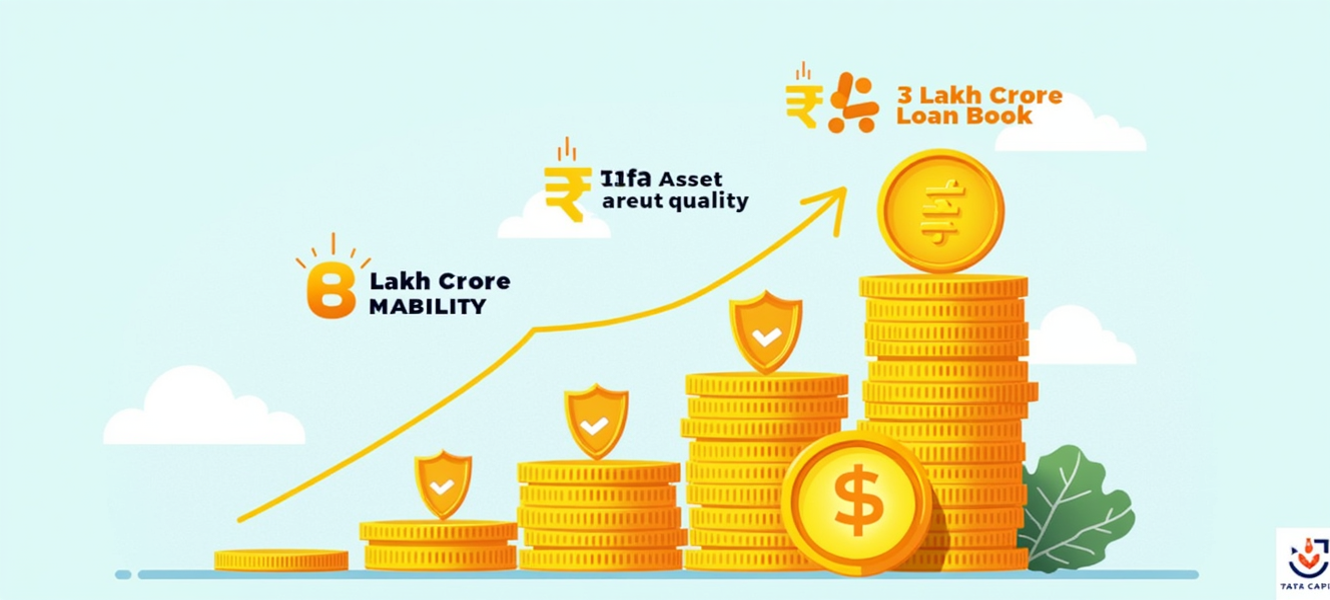
Tata Capital Limited announced a 51% year-on-year increase in PAT to ₹1,660 crore for the quarter ended September 30, 2026. The company's loan book crossed ₹3,08,030 crore, reflecting a 26% annual growth. Asset quality remained stable with GNPA at 1.9% and credit cost at 0.9%. Retail and SME loans sustained a strong 85.4% share of net AUM, while operating efficiency improved to a 35.3% cost-to-income ratio.
Tata Capital Limited
Investor Presentation
Tata Capital Limited reported a 51% year-on-year increase in profit after tax to ₹1,660 crore for the quarter ending September 30, 2026, driven by a loan book that crossed ₹3,08,030 crore, marking a 26% annual growth while maintaining stable asset quality and improved operational metrics.
The company's net assets under management (AUM) witnessed a 26% growth year-over-year to ₹3,08,030 crore as of September 2026, with a notable exclusion of motor finance driving 32% YoY net AUM growth. Retail and small and medium enterprise (SME) loans remained the key focus, accounting for 85.4% of the net AUM, and unsecured retail loans forming 10.4%.
Operating efficiency improved with a cost-to-income ratio declining to 35.3% from 39.7% in the prior year quarter, and cost to average asset ratio reduced to 2.3%. Net interest income rose 23% YoY to ₹3,696 crore. The company employed 31,655 on-roll employees, growing by 6% compared to a 26% growth in AUM.
Asset quality stayed stable; gross non-performing assets (GNPA) stood at 1.9%, down from 2.2% a year earlier, and net non-performing assets (NNPA) at 0.8%. Annualized credit cost further improved to 0.9%. Return on assets (ROA) increased from 1.9% to 2.3%, and return on equity (ROE) rose from 13.0% to 14.0% year-over-year.
Tata Capital continued to enhance its presence with 1,515 branches across 26 states and union territories, leveraging a hybrid physical and digital (Phygital) approach to serve a customer franchise of 9.2 million. Total equity reached ₹47,778 crore, with total borrowings at ₹2,60,846 crore and a borrowing-to-equity ratio of 5.5 times, maintaining a liquidity buffer of ₹36,398 crore.
Highlights
- Loan book crossed ₹3,08,030 crore, up 26.3% YoY
- Profit after tax (PAT) grew 51.3% YoY to ₹1,660 crore
- Net AUM grew 26% YoY; excluding Motor Finance growth was 32% YoY
- Retail and SME loans remain stable at 85.4% of net AUM
- Annualized credit cost improved to 0.9%; GNPA at 1.9%, NNPA at 0.8%
- Cost-to-income ratio improved to 35.3% from 39.7% YoY, net interest income rose 23% YoY to ₹3,696 crore
Key Data Snapshot
What happened
- Tata Capital's loan book surpassed ₹3 lakh crore, reaching ₹3,08,030 crore as of September 30, 2026, showing 26% growth compared to the previous year.
- The company reported a 51% year-on-year increase in profit after tax to ₹1,660 crore for the second quarter of fiscal 2027.
- Net assets under management (AUM) excluding motor finance grew 32% year-on-year, underpinning strong lending growth.
- Retail and SME loans accounted for 85.4% of net AUM, evidencing sustained focus on these segments.
- Asset quality remained stable with gross non-performing assets at 1.9% and net non-performing assets at 0.8%.
Key details
- Operating efficiency improved with cost-to-income ratio reduced to 35.3% from 39.7% in Q2FY26 and cost to average assets dropped to 2.3%.
- Net interest income increased 23% year-on-year to ₹3,696 crore.
- The company maintained a liquidity buffer of ₹36,398 crore as of September 2026 on a consolidated basis.
- Total equity stood at ₹47,778 crore with total borrowings at ₹2,60,846 crore, resulting in a borrowings to equity ratio of 5.5 times.
- The average cost of borrowings increased by 5 basis points sequentially to 7.3%.
Business impact
- Customer franchise reached 9.2 million with around 0.4 million customers added during Q2FY27.
- A physical and digital (Phygital) network expanded to 1,515 branches across 26 states and union territories.
- Returns improved with annualized ROA up to 2.3% and ROE to 14.0%, reflecting profitability enhancement.
- Credit cost improved, indicating effective asset quality management during the quarter.
Highlights
- Loan book crossed ₹3,08,030 crore, up 26.3% YoY
- Profit after tax (PAT) grew 51.3% YoY to ₹1,660 crore
- Net AUM grew 26% YoY; excluding Motor Finance growth was 32% YoY
- Retail and SME loans remain stable at 85.4% of net AUM
- Annualized credit cost improved to 0.9%; GNPA at 1.9%, NNPA at 0.8%
- Cost-to-income ratio improved to 35.3% from 39.7% YoY, net interest income rose 23% YoY to ₹3,696 crore
Disclosures
- Securities and Exchange Board of India (Listing Obligations and Disclosure Requirements) Regulations, 2015
Tata Sons holds 78.8% stake in Tata Capital Limited.
Source Information
More News on Investor Presentation
View allLatest corporate announcements and market updates in Investor Presentation.

APAR Industries Reports Highest Ever Revenue and Announces Rs 1,500 Crore Capex for Financial Year 2027
APAR Industries Limited shared its October 2026 corporate presentation revealing its highest consolidated revenue to date for FY 2025-26 and outlining a robust Rs 1,500 crore capital expenditure plan for FY27 aimed at scaling operations and capturing emerging opportunities in the energy infrastructure sector.
Read Full Story
APAR Industries Posts Rs. 914.80 Crore Profit After Tax in H1 FY 2026-27, Approves USD 100 Million Investment in Singapore Subsidiary
APAR Industries Limited announced unaudited standalone and consolidated financial results for the quarter and half-year ended September 30, 2026, posting a consolidated profit after tax of Rs. 914.80 crore for the half year of FY 2026-27.
Read Full Story
Schaeffler India Limited Shares Q3 CY26 Industry and Economic Highlights Showing Strong Automotive Sector Growth
Schaeffler India Limited disclosed its Q3 CY26 investor presentation detailing key economic indicators and industry sector performances including significant growth in automotive production volumes during the quarter.
Read Full Story




